
What is Limp Mode on a Car? Can You Bypass Limp Mode or Disable It?
October 25, 2026
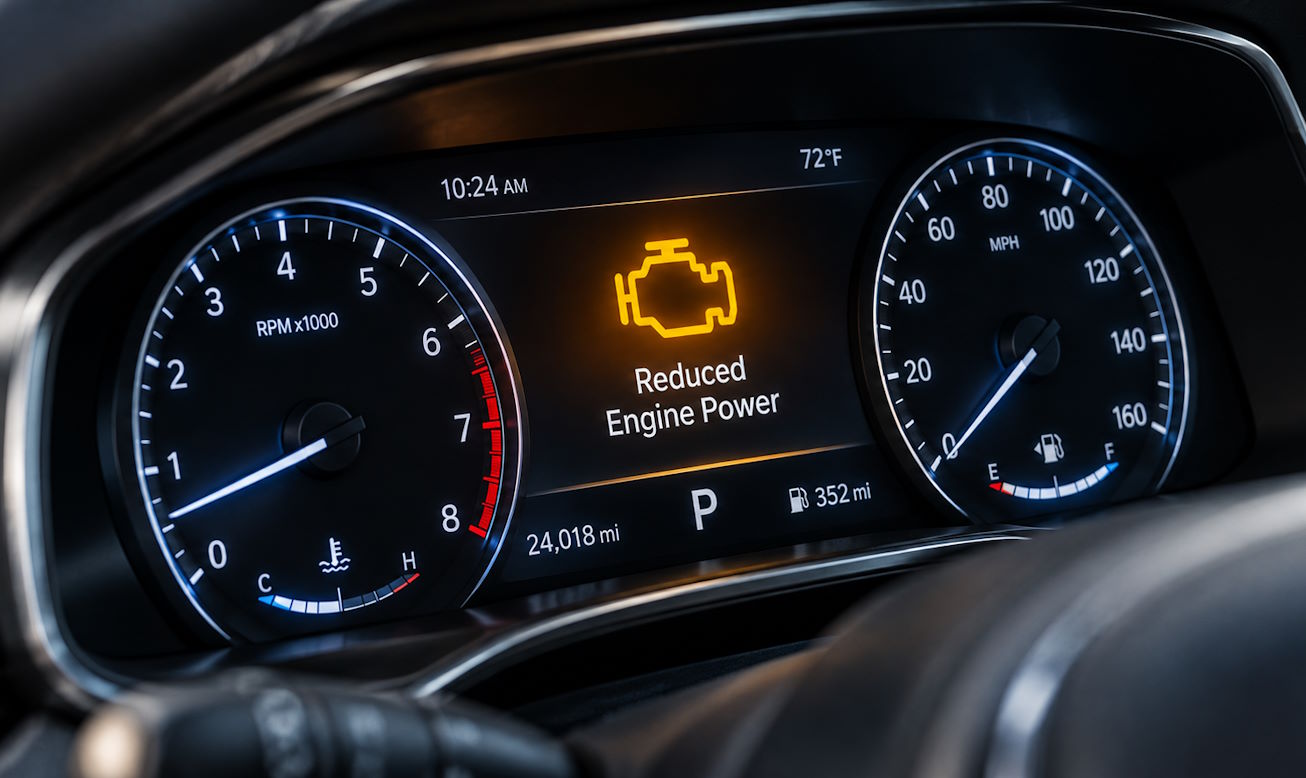
You’re driving down the road when suddenly your car loses power, struggles to accelerate, or refuses to shift gears normally. You might even notice a check engine light or a “Reduced Engine Power” warning on your dashboard. If this sounds familiar, your car may have entered what’s known as limp mode.
While having your car in limp mode can be frustrating, it’s actually a built-in safety feature designed to protect your engine and transmission from potentially serious damage. But what exactly causes it, and more importantly, how do you get your car out of limp mode?
In this guide, the mechanics at Mike’s Auto Service explain what limp mode means, how to recognize the symptoms, and whether it’s possible to bypass or disable it safely.
What Is Limp Mode on a Car?
Limp mode is a protective operating mode that limits your vehicle’s performance when its onboard computer detects certain engine, transmission, or electronic system problems. Rather than allowing the vehicle to operate normally and potentially cause additional damage, the computer reduces power or restricts certain functions.
The limp mode meaning is fairly straightforward: your car is limiting its performance because something isn’t working correctly.
Depending on the vehicle and the underlying issue, car limp mode may:
- Limit engine RPMs to prevent excessive stress.
- Reduce acceleration and overall engine power.
- Restrict the transmission to a particular gear.
- Disable certain performance-related functions.
- Illuminate the check engine light or other dashboard warnings.
Not every vehicle behaves the same way in limp mode. Some cars experience only a noticeable reduction in power, while others may barely accelerate or shift gears.
Think of limp mode as your vehicle’s way of telling you that something needs attention before you continue driving normally.
What Causes a Car to Go Into Limp Mode?
Several mechanical and electronic problems can trigger limp mode. Modern vehicles rely on numerous sensors and computer-controlled systems, and when something goes wrong, the vehicle may limit performance as a precaution.
1. Transmission Problems
Transmission-related issues are among the possible causes of limp mode. Problems with transmission sensors, solenoids, fluid pressure, or internal components can cause the transmission control module to restrict shifting.
Some vehicles may become stuck in a single gear to reduce the risk of further transmission damage.
2. Faulty Engine Sensors
Your vehicle uses sensors to monitor airflow, throttle position, engine temperature, and other operating conditions. If one of these sensors fails or sends incorrect information, the engine computer may reduce power.
Potentially problematic components include:
- Mass airflow (MAF) sensors
- Throttle position sensors
- Accelerator pedal position sensors
- Manifold absolute pressure (MAP) sensors
- Engine temperature sensors
Not every sensor malfunction will activate limp mode, but certain failures can interfere with the computer’s ability to manage engine performance safely.
3. Overheating Engine
Excessive engine temperatures can cause some vehicles to enter a reduced-power mode to help prevent overheating-related damage.
Problems with the cooling system, including low coolant, a failing water pump, or a malfunctioning thermostat, may contribute to overheating.
Important: If your temperature gauge indicates overheating, stop driving as soon as it’s safe. Do not assume limp mode will prevent engine damage.
4. Electronic Throttle Control Problems
Many modern vehicles use electronic throttle control systems instead of traditional mechanical throttle cables. If the system detects a problem with the throttle body, accelerator pedal sensor, or related wiring, it may limit engine power.
In some vehicles, this triggers a warning such as “Reduced Engine Power.”
For more information, read our guide on what the Engine Power Reduced warning means.
5. Turbocharger or Boost Pressure Issues
On turbocharged vehicles, problems with boost pressure, turbocharger controls, or related sensors can trigger limp mode.
For example, if the engine computer detects excessive boost pressure, it may reduce engine output to protect internal components.
6. Electrical or Wiring Problems
Damaged wiring, loose connectors, poor electrical connections, and certain charging system problems can interfere with the signals your vehicle’s computers rely on.
These problems may cause intermittent limp mode, where the vehicle operates normally one moment and suddenly loses power the next.
What Are the Symptoms of a Car in Limp Mode?
If you’re wondering whether your car is in limp mode, there are several common warning signs to watch for.
- Sudden loss of power: Your vehicle feels unusually sluggish, especially when accelerating.
- Limited engine RPMs: The engine may refuse to rev beyond a certain point.
- Transmission shifting problems: Your car may stay in one gear or shift differently than normal.
- Check engine light: A warning light may appear on your dashboard.
- Reduced top speed: The vehicle may struggle to reach normal driving speeds.
- Poor throttle response: Pressing the accelerator produces little or delayed acceleration.
Keep in mind that these symptoms can also be caused by other mechanical problems. A professional diagnostic inspection is the best way to determine whether your car has entered limp mode and why.
How to Get a Car Out of Limp Mode
If your car goes into limp mode, the first priority is determining whether it’s safe to continue operating the vehicle.
While some problems may temporarily clear after restarting the engine, others require immediate mechanical attention.
Step 1: Pull Over Somewhere Safe
If your car suddenly loses power, avoid aggressive acceleration and find a safe place to pull over. Turn on your hazard lights if necessary.
If the vehicle is overheating, making unusual noises, displaying a low oil pressure warning, or experiencing severe transmission problems, shut off the engine and arrange for a tow.
Step 2: Check for Obvious Problems
Once parked safely, look for obvious warning signs such as fluid leaks, smoke, or unusual smells. Check your dashboard for warning lights or messages.
If the engine has cooled completely, you may also check fluid levels according to your owner’s manual. Never open a hot radiator cap or pressurized cooling system.
Step 3: Try Restarting the Vehicle
If there are no signs of overheating, low oil pressure, or another serious problem, you can try turning off the engine, waiting briefly, and restarting it.
In some cases, restarting the vehicle may temporarily clear a reduced-power condition.
However, restarting your car does not fix the underlying problem. If a fault is still present, limp mode may return immediately or after you begin driving again.
Step 4: Read the Diagnostic Trouble Codes
An OBD-II scanner can retrieve diagnostic trouble codes stored by your vehicle’s computer. These codes provide valuable clues about which systems may be malfunctioning.
However, a trouble code doesn’t always identify the exact component that needs replacement. Some transmission and manufacturer-specific codes may also require more advanced diagnostic equipment.
A qualified mechanic can interpret the codes, inspect the affected systems, and identify the root cause.
Step 5: Repair the Underlying Problem
The most reliable way to get a car out of limp mode is to correct the condition that triggered it.
Depending on the diagnosis, this could involve:
- Replacing a faulty sensor.
- Repairing damaged electrical wiring.
- Addressing transmission fluid or pressure problems.
- Repairing the electronic throttle system.
- Fixing cooling system problems.
- Repairing turbocharger or boost control components.
Once the problem is repaired, a technician may clear stored fault codes, perform necessary relearn procedures, and verify that the vehicle operates normally.
How to Bypass Limp Mode: Is It Possible?
One of the most common questions drivers ask is how to bypass limp mode without visiting a mechanic.
Although certain temporary resets may restore normal performance in some situations, there is no universal or reliable way to bypass limp mode safely.
Some drivers attempt to bypass limp mode by disconnecting the battery, clearing diagnostic codes, or repeatedly restarting the vehicle. These approaches generally do not correct the underlying malfunction.
In fact, clearing diagnostic codes before having the vehicle inspected can erase useful troubleshooting information and make the problem more difficult to identify.
Attempting to override protective controls can also expose the engine or transmission to additional damage.
Our recommendation: Rather than trying to bypass limp mode, have the underlying issue diagnosed and repaired. This is the safest and most dependable way to restore normal vehicle performance.
Can You Disable Limp Mode Permanently?
If you’ve experienced repeated limp mode problems, you might be wondering how to disable limp mode permanently.
While certain vehicle computer modifications may alter factory protective settings, permanently disabling limp mode is not recommended.
Limp mode exists to protect expensive mechanical components, including your engine and transmission. Disabling these protections can allow a vehicle to continue operating under conditions that may cause serious damage.
It can also create safety concerns if the vehicle experiences a mechanical or electronic failure while driving.
If your car repeatedly enters limp mode, the proper solution is to identify and repair the recurring problem rather than disable the protection system.
Can You Drive a Car in Limp Mode?
Some vehicles are designed to permit limited driving while in limp mode, but that doesn’t mean it’s always safe to continue driving.
Whether you can drive depends on the reason limp mode was activated, the severity of the symptoms, and your vehicle manufacturer’s recommendations.
For example, a vehicle experiencing reduced throttle response may still be capable of moving slowly. However, a car with severe overheating or transmission damage should not be driven.
As a general rule:
- Avoid highway driving and high-speed roads.
- Do not accelerate aggressively or place additional strain on the vehicle.
- Do not continue driving if the engine is overheating or the oil pressure warning is illuminated.
- Arrange for towing if the vehicle cannot maintain safe speeds or operate predictably.
- Have the problem diagnosed as soon as possible.
When in doubt, towing your vehicle to a repair shop is generally safer than risking additional damage or getting stranded.
How Much Does It Cost to Fix Limp Mode?
The cost to repair a car in limp mode depends entirely on what’s causing the problem.
For example, repairing a loose electrical connection may be relatively inexpensive, while replacing a throttle body, repairing a turbocharger, or addressing an internal transmission failure can be significantly more costly.
Because limp mode is a symptom rather than a specific mechanical failure, there isn’t one standard repair price.
A professional diagnostic inspection helps determine the necessary repairs before you spend money replacing parts that may not be defective.
Frequently Asked Questions About Limp Mode
What Does Limp Mode Mean on a Car?
Limp mode means your vehicle’s computer has detected a problem and is limiting certain functions to help protect the engine, transmission, or related systems. It often results in reduced acceleration, limited RPMs, or restricted transmission shifting.
Will Limp Mode Go Away on Its Own?
Sometimes limp mode temporarily disappears after restarting the vehicle or when an intermittent fault is no longer present. However, the underlying problem may still exist, and limp mode can return. Professional diagnostics are recommended even if the vehicle begins operating normally again.
Can a Bad Battery Cause Limp Mode?
Yes, in some vehicles, low system voltage or charging system problems can interfere with electronic controls and contribute to reduced-power operation. However, a weak battery does not automatically cause limp mode, and the electrical system should be tested before replacing components.
Can Low Transmission Fluid Cause Limp Mode?
Yes. On certain vehicles, low transmission fluid can contribute to pressure problems, overheating, or shifting faults that trigger a transmission protection mode. Fluid levels and transmission condition should be checked using the manufacturer’s recommended procedure.
Does Disconnecting the Battery Reset Limp Mode?
Disconnecting the battery may reset certain electronic systems on some vehicles, but it is not a dependable fix for limp mode. The problem may return, and disconnecting the battery can erase diagnostic information or require electronic systems to relearn settings.
How Do You Get a Car Out of Limp Mode Permanently?
The best way to permanently resolve recurring limp mode is to diagnose and repair the fault that activates it. Once the underlying issue is corrected, the vehicle should be able to operate normally without bypassing its protective systems.
Can Limp Mode Damage Your Car?
Limp mode itself is generally intended to reduce the risk of damage. However, the mechanical problem that triggered it may still cause damage if you continue driving. Never ignore overheating, low oil pressure, severe shifting problems, or other serious warning signs.
Car Stuck in Limp Mode? Visit Mike’s Auto Service in Newington, CT
If your car is stuck in limp mode, experiencing reduced engine power, or struggling to accelerate, don’t ignore the warning signs.
At Mike’s Auto Service in Newington, Connecticut, our ASE-certified technicians have the experience and diagnostic equipment to identify engine, transmission, and electrical problems affecting your vehicle’s performance.
We provide comprehensive auto repair and diagnostic services for domestic, foreign, and European vehicles, helping drivers throughout Newington, New Britain, Wethersfield, West Hartford, and surrounding Connecticut communities.
Whether you’re dealing with a faulty sensor, transmission trouble, or an unexplained loss of power, our team can help determine the cause and recommend the appropriate repairs.
Don’t let limp mode leave you stranded. Contact Mike’s Auto Service or call (860) 667-1426 to schedule an appointment today.